How to keep AI automation from doing the same job twice
AI automation can fail. The important part is making sure it does not send the same email twice, create the same payment twice, or leave people guessing where the work stopped.
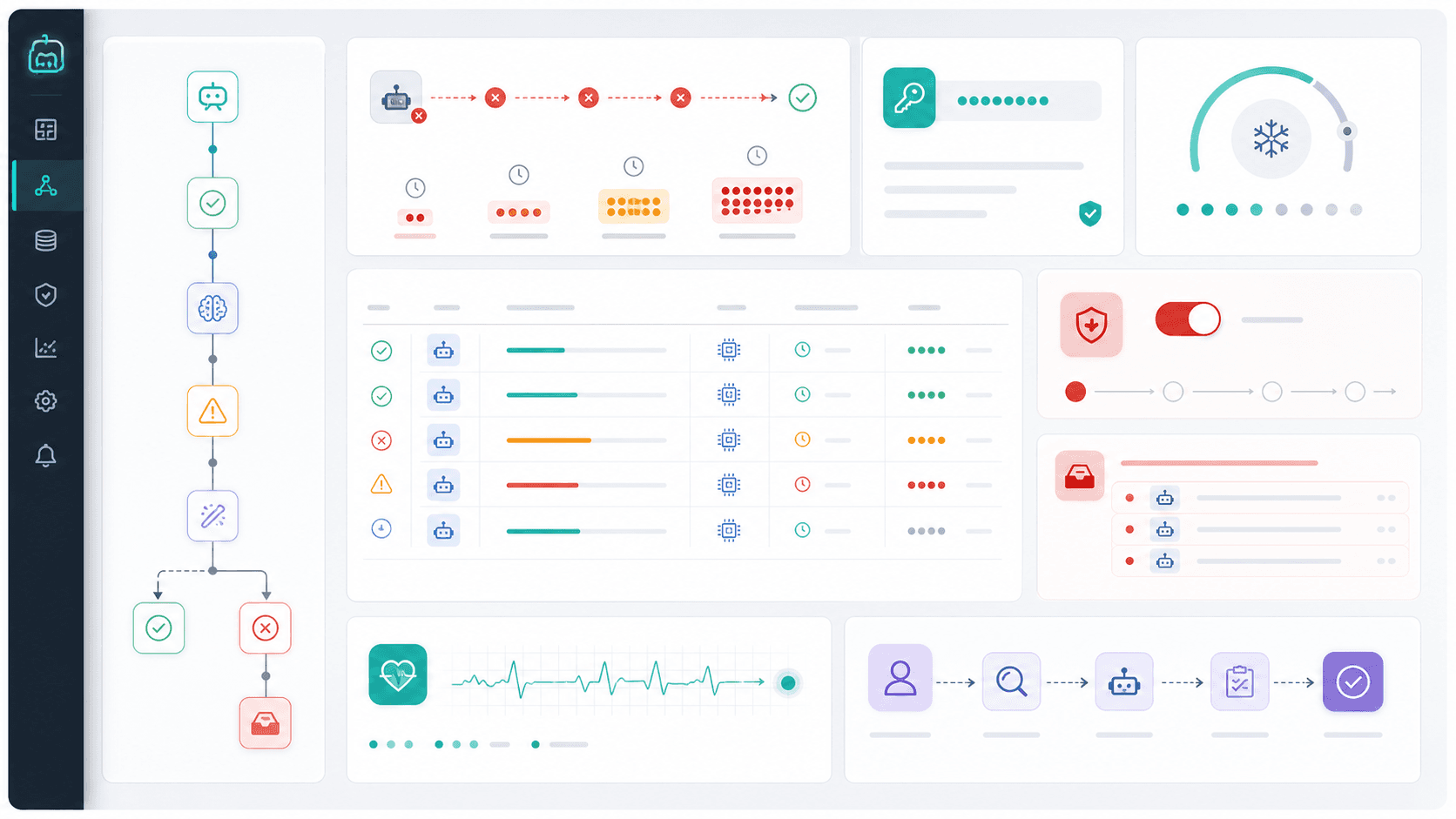
AI automation reliability guide
Imagine an AI workflow that writes a customer email, updates a CRM record, checks a payment, and publishes a blog post. The main risk is not that it fails once. The real risk is that it fails in the middle, tries again blindly, and creates the same business result twice. Reliable AI automation starts by deciding what should happen when the first attempt is unclear.
1. Overview: the real risk starts when automation stops halfway and runs again
Most AI automation demos show the first run. A button is clicked, the AI does the work, and the output appears. Real operations begin after the demo. What if the customer email was already sent but the screen ended with an error? What if the payment check succeeded but the AI never received the confirmation? What if a blog publish is still deploying and the agent tries to publish the same post again?
Official reliability guidance from cloud and payment systems points to the same lesson. Temporary failures can often be retried. But if the system does not know whether the business action already happened, retrying can create duplicate emails, duplicate payments, duplicate posts, or duplicate record changes.
So reliable AI automation is not just a better prompt. It needs duplicate-prevention rules, slower retry rules, and a work log that lets a person see where the workflow stopped. Engineers may call these idempotency, backoff, and run ledgers. Operators can read them as duplicate prevention, careful retry, and an automation work log.
2. The technical words in business language
Retry means trying again. It makes sense when the internet blinks or an outside service is briefly busy. It does not make sense for every failure. If the action touches customers, money, public publishing, or official records, the workflow first needs a rule that prevents duplicates.
Duplicate prevention, or idempotency, means the same request can arrive twice but create the business result only once. Think of it as putting an order number on every action. If the same order number returns, the system should recognize it as the same intent.
Backoff means waiting longer after repeated failures. Jitter means spreading retry times so many automations do not rush at the same moment. Cooldown means giving a failing tool time to recover. A dead-letter queue is a review shelf for work that failed too many times. A run ledger is the automation work log.
- Try again: useful for temporary failures.
- Duplicate prevention: stop the same email, payment, post, or record change from happening twice.
- Careful retry: wait longer after repeated failures.
- Review shelf: stop looping and move failed work to a person.
- Automation work log: record what ran, where it stopped, and who owns the next step.
3. The root cause: AI agents take action in an uncertain world
A normal chat answer can be wrong without changing the outside world. Automation is different. It sends emails, edits files, calls APIs, updates records, charges money, publishes posts, and schedules follow-up work. Once an agent can touch the world, the main risk is not only hallucination. It is duplicated action, partial completion, stale state, hidden failure, and cost amplification.
This is the root reason retry and idempotency matter. A failed response does not always mean the action failed. The downstream service may have created the object but the confirmation never reached the agent. A browser automation may have clicked submit but crashed before saving the screenshot. A scheduled job may have started before a machine reboot and then restarted after the reboot. Without a ledger, the system has memory loss.
Reliable automation treats uncertainty as normal. It classifies the failure before retrying. It records the action before and after the side effect. It reuses the same idempotency key for the same intent. It stops when the error is not transient. It asks a human when the next step changes money, customer trust, legal exposure, public publishing, or irreversible state.
4. Separate work that is safe to retry from work that must stop
A practical team can divide failures into five groups. Some failures can be retried right away. Some need the input fixed first. Some need a waiting period. Some need a human. Some should stop completely.
A broken connection can usually be retried. A missing customer name needs a fix. A rate limit needs waiting. A payment that may already have succeeded needs a human check. A forbidden file does not become available because the AI tries ten more times.
The model can make the next attempt sound reasonable, but reasonable language is not a safety rule. The workflow should say when to retry, when to wait, when to stop, and when to hand off to a person.
- Temporary: connection drop, temporary server error, briefly busy service.
- Fix first: missing customer name, required field, wrong file format.
- Wait first: rate limit, maintenance window, temporary lock.
- Human review: money, customer trust, legal judgment, public publishing, hard-to-reverse changes.
- Stop: forbidden action, missing permission, business rule violation.
5. Duplicate prevention is the brake for risky actions
Idempotency is easiest to understand through payment systems, but the same idea applies to AI operations. If the agent says "send this onboarding email," the system should attach a stable action id. If the network drops after sending, the retry should ask about the same action id rather than inventing a new one. The result should be "already sent" or the original result, not a second email.
Stripe documents this pattern for payment-style API requests. AWS describes a similar client request identifier pattern. The words differ, but the lesson is the same: the system must recognize when a request represents the same intent.
A small company can write this rule plainly. Reading information is usually safe to retry. Changing state needs an action number. Expensive live work needs a budget and a cooldown. Public or customer-facing work needs approval or a rollback path. Money movement needs a duplicate-prevention key and a reconciliation record.
6. Slower retries stop a small failure from becoming a bigger one
Retry can make a system more reliable, but careless retry can make an outage worse. If an outside service is already struggling and every AI workflow immediately tries again, the service receives more work at the worst moment.
That is why failed work should slow down. Repeated attempts should wait longer. Many workers should not retry at the same moment. A tool that keeps failing should rest for a while. After enough failures, the workflow should stop and move to review.
For example, a research automation should stop after search limits. A publishing automation should not publish the same article again while deployment is slow. A scraping automation should move to review when a website layout changes instead of continuing to hit the site.
7. The run ledger: an automation work log that shows where the workflow stopped
The run ledger is one of the most underrated parts of AI automation. It is not glamorous, but it turns "the AI did something" into "we know what happened." For nontechnical readers, think of it as an automation work log.
The minimum log is simple: when did it run, why did it run, what was it trying to do, how many times did it try, did it succeed, where did it stop, and who should take over? Engineering teams can add run id, input hash, and idempotency key on top of that.
This log also makes improvement possible. When the same failure repeats, the answer should not be "the AI failed again." The answer should be "update the checklist," "add an approval step," "clarify the SOP," or "reduce the automation scope."
- When did it run?
- What was it trying to do?
- How many times did it try?
- Did it succeed, fail, or end in an unclear state?
- Where is the output or evidence?
- Who should take over?
- What should change so the same failure is less likely next time?
8. What this looks like in real projects
A blog publishing automation is a simple example. Creating the article file is not enough. The workflow should check the image, the three localized pages, the blog lists, the sitemap, the live URL, and the final response code. That is the publishing work log.
A market-scanning workflow has a different version of the same rule. Reading cached prices may be safe to retry. Placing an order, sending a customer alert, charging money, or publishing a recommendation is not the same kind of action. Those steps need duplicate prevention before autonomy.
The same thinking applies to GUILDEX. A customer-facing workflow should not only produce a good draft. It should say which source it used, which customer context it touched, whether human approval is required, how duplicates are prevented, and where the result is recorded.
9. Why humans must improve as AI improves
As AI improves, the human role does not disappear. It moves upward. People may type fewer repeated tasks, but they must get better at deciding what the AI may do, where it must stop, what evidence it must leave, and which actions need human approval.
The weak version of AI adoption says, "Let the agent handle it." The strong version says, "Here is the goal, here is the trusted source, here is the duplicate-prevention rule, here is the approval boundary, here is the work log, and here is how we learn from failure." That is not less human work. It is more valuable human work.
The next practical step is simple: choose one recurring workflow and add a work log before adding more autonomy. Then add a duplicate-prevention number for every action that should happen only once. Then decide when to retry and when to stop. Once that loop is visible, AI automation becomes a business process, not a lucky prompt.
10. Seven questions to ask before making an AI workflow autonomous
You do not need to memorize every technical term in this article. If your team can answer the questions below, the automation is becoming easier to trust. If not, keep a human review step before full automation.
- What goes wrong if this automation does the same work twice?
- How do we check whether an unclear run already succeeded?
- Which steps are safe to retry, and which steps are risky?
- After how many failures does the workflow stop and hand off to a person?
- Where is the work log?
- Is there approval before customers, money, contracts, or public publishing are affected?
- When the same failure repeats, which SOP or checklist changes?
참고자료
- AWS Builders Library: Making retries safe with idempotent APIs
- AWS Builders Library: Timeouts, retries, and backoff with jitter
- AWS Prescriptive Guidance: Retry with backoff pattern
- Stripe docs: Idempotent requests
- Google Cloud Storage docs: Retry strategy
- Microsoft Learn: Retry pattern
- Microsoft Learn: Circuit Breaker pattern
- Amazon SQS docs: Using dead-letter queues
- Google Cloud Pub/Sub docs: Dead-letter topics
- Google SRE book: Distributed periodic scheduling with cron
- Google SRE book: Addressing cascading failures
- OpenAI Agents docs: Integrations and observability
- OpenAI Cookbook: Agent improvement loop with traces, evals, and Codex
- arXiv: Self-Healing Agentic Orchestrators for Reliable Tool-Augmented LLM Systems
- arXiv: Do AI Coding Agents Log Like Humans? An Empirical Study
- X: Hermes ecosystem signal on agent workspaces, memory, skills, sub-agents, and operations layers
- X: Loop engineering signal on schedules, state files, budgets, and stopping conditions
- X: Hermes automation blueprint signal on scheduled research agents
- X: SkillOpt signal on bounded skill updates and agent experience loops
Make AI automation safe enough for daily work
Guildex Fit Check turns repeated work into clear sources, duplicate-prevention rules, approval points, work logs, and verification steps so AI workflows can move from demo to daily operation.