How to organize company knowledge so AI can use it
AI agents do not need a pile of documents. They need structured company knowledge: purpose, procedure, exceptions, decision criteria, forbidden actions, source citations, and update ownership.
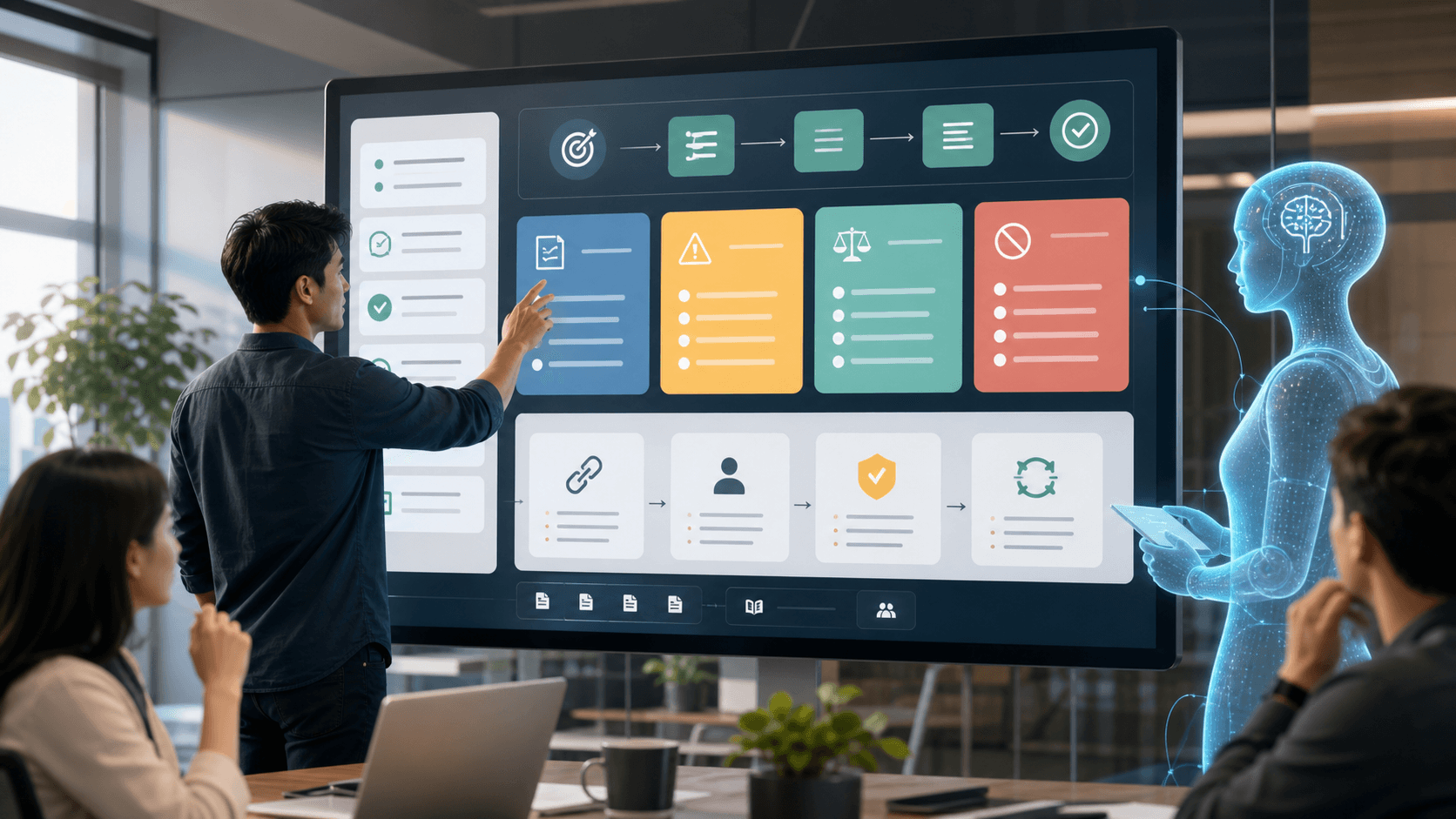
AI knowledge operations guide
Uploading more documents is not the same as preparing company knowledge for an AI agent. A useful agent needs knowledge that is structured like work: what the goal is, what steps to follow, where exceptions live, which decision criteria matter, what must never happen, and who updates the rule when reality changes.
1. Overview: document upload is not knowledge design
After a team chooses the first AI agent workflow, the next question is usually: "What should the agent read?" The easy answer is to upload the wiki, drive folder, Notion pages, Slack summaries, and old meeting notes. That feels thorough, but it often creates a different problem: the agent can retrieve words, but not operating judgment.
OpenAI file search shows why retrieval is useful: documents can be parsed, chunked, embedded, searched with both keyword and semantic search, and reranked before the model answers. Google and Microsoft also describe grounding agents in configured data sources. These systems make retrieval possible. They do not guarantee that the underlying company knowledge is clear, current, permission-safe, or decision-ready.
For an operator, the practical rule is simple. Before connecting a knowledge source to an agent, turn the work into a readable operating card. The card should say what the workflow is for, how it is done, which exceptions matter, when to ask a human, what the agent must not do, and where each rule came from.
2. The five parts of AI-readable company knowledge
AI-readable knowledge has five parts. First is purpose: why this workflow exists and what good output looks like. Second is procedure: the normal steps a trained employee would follow. Third is exceptions: the cases where the normal rule breaks.
Fourth is decision criteria: the specific signals used to choose between options. Fifth is forbidden actions: what the agent must not do even if the user asks, the data appears available, or the model is confident.
This matters because agents do not only answer questions. They route, draft, classify, summarize, recommend, and sometimes call tools. If the knowledge only says "handle refunds carefully," the agent has no operating boundary. If the knowledge says "draft refund language under these conditions, escalate above this amount, never issue the refund without approval," the agent can work inside a safer box.
- Purpose: the business outcome and quality target.
- Procedure: the normal step-by-step path.
- Exceptions: unusual cases, customer edge cases, and policy conflicts.
- Decision criteria: the signals that decide which path to choose.
- Forbidden actions: actions the agent may not take or recommend without escalation.
3. Small dictionary: SOP, CLAUDE.md, RAG, grounding, citation, freshness
SOP means standard operating procedure. In plain language, it is the company recipe for how a task should be done. A good SOP is not only a checklist. It also explains the purpose, examples, exceptions, approval rules, and what to do when the case is unclear.
A CLAUDE.md-style file is an AI briefing. It tells an AI assistant the stable rules of a project: how the team works, what commands matter, what style to follow, which risks to avoid, and which files are important. It is useful context, but it is not enforcement. Permissions, approvals, logs, and evals still matter.
RAG means retrieval-augmented generation. In business language, the AI looks up relevant company material before answering instead of relying only on memory. Grounding means the answer is tied to a source. A citation is the source link or document reference that lets a human check where the answer came from. Freshness means whether that source is still current.
- SOP: the work recipe plus judgment rules.
- CLAUDE.md: a standing briefing for an AI assistant, not a legal control.
- RAG: search the company knowledge first, then answer.
- Grounding: answer from a source, not just from general model knowledge.
- Citation: the human-checkable source behind the answer.
- Freshness: the date or owner signal that tells whether the rule is still valid.
4. Why exceptions matter more than the normal path
Most teams document the happy path first. That is useful, but AI agents often fail at the boundary: the unusual customer, the missing field, the policy conflict, the old contract, the VIP exception, the urgent but suspicious request, the case that looks like one category but belongs to another.
Anthropic context engineering argues that agents need relevant context at the right time, not the entire corpus stuffed into the prompt. That is the same lesson for business knowledge. The agent needs a small set of examples and counterexamples that teach the boundary between paths.
For a customer reply agent, do not only write "answer politely." Add examples of when to apologize, when to ask for more information, when to refuse, when to escalate, and when to avoid promising anything. A few good edge cases can do more for reliability than twenty pages of vague policy.
- Example: a normal refund request with all fields present.
- Counterexample: a refund request above the approval threshold.
- Counterexample: a customer asks for a policy exception.
- Counterexample: the source document conflicts with a newer notice.
- Counterexample: the agent has enough text to draft, but not enough authority to act.
5. Good knowledge structure: one workflow card, examples, and source trail
For the first rollout, avoid building a giant knowledge base. Start with one workflow card. The card should fit on one screen and link to deeper documents only where needed. This keeps the agent and the reviewer focused.
A good workflow card contains: owner, last updated date, source links, workflow purpose, input fields, normal steps, examples, edge cases, approval threshold, no-go rules, output format, and escalation path. The reviewer should be able to inspect the card and decide whether the agent used the right rule.
Microsoft Copilot Studio highlights a related idea: knowledge sources can be scoped and grounded, and user authentication can affect what content is surfaced. For a small company, the same principle is enough. Do not flatten every document into one open bucket. Keep sensitive, stale, or role-specific knowledge scoped.
- One card per workflow, not one huge company brain.
- Links to original sources, not copied fragments with no origin.
- Examples and counterexamples, not only abstract rules.
- Approval and escalation rules next to the task, not hidden in a separate policy folder.
- Named update owner and last reviewed date.
6. Bad knowledge structure: long meeting notes, stale wiki pages, and hidden tribal knowledge
Bad AI knowledge usually looks impressive from the outside. There are many documents, many channels, many folders, and many historical decisions. The problem is that nobody knows which rule wins when two sources conflict.
Long meeting notes are especially risky because they mix ideas, decisions, jokes, objections, and outdated plans. A stale wiki page is worse than no wiki because the answer looks official while being wrong. Hidden tribal knowledge creates another failure: the agent answers from the document, but the real company rule lives inside one senior employee.
Reddit discussions around real agent workflows keep circling the same issue: too little context causes hallucination, but too much context buries the signal, and stale indexes break RAG. Treat this as community signal only, but the operational lesson is solid. Knowledge quality is not measured by document count. It is measured by how quickly the agent and reviewer can find the current rule.
- Bad: "Read all meeting notes and decide."
- Better: "Use the approved refund SOP, then consult meeting notes only as background."
- Bad: "All documents are available to every agent."
- Better: "This workflow can read these sources and must cite which one it used."
- Bad: "The team knows the exception."
- Better: "The exception is written, dated, sourced, and assigned to an owner."
7. Checklist before connecting knowledge to an agent
Before connecting the knowledge source, answer the operating questions. What can the agent read? Which source wins when documents conflict? What is too sensitive to retrieve? Who updates the SOP? How will reviewers mark missing or wrong knowledge? Which eval cases prove the agent can use the knowledge correctly?
OpenAI and Anthropic both point toward systems where instructions, tools, retrieval, context, evals, and guardrails work together. The same is true for a non-technical team. Company knowledge is not a folder. It is a living operating layer.
- Read boundary: which sources may this workflow use?
- Source priority: what wins when two documents disagree?
- Privacy boundary: which data must be masked, excluded, or kept local?
- Update owner: who reviews the rule when reality changes?
- Citation rule: must every answer show its source?
- Eval set: which examples test whether the agent used the rule correctly?
- Feedback loop: how does a reviewer turn a mistake into a better SOP?
8. Conclusion: the real preparation is readable operating knowledge
The model matters. The retrieval system matters. The tool stack matters. But the first bottleneck for many companies is simpler: the company itself has not written the work in a way an agent can read and a human can audit.
Start with one workflow. Write the purpose, steps, exceptions, decision criteria, forbidden actions, sources, owner, and eval cases. Then connect the agent. That is how company knowledge becomes an operating asset instead of a document dump.
참고자료
- OpenAI API docs: Agents
- OpenAI API docs: File Search
- Anthropic: Effective context engineering for AI agents
- Anthropic: Equipping agents for the real world with Agent Skills
- Microsoft Learn: Knowledge sources in Copilot Studio
- Google Cloud: Grounding with your data
- NIST AI Risk Management Framework
- Reddit r/AI_Agents: knowledge layer, trust, and provenance signal
- Reddit r/AI_Agents: real workflow context selection signal
- X: local company knowledge graph and MCP signal
- X: repeated context explanation and CLAUDE.md signal
- X: markdown company OS and SOP signal
Make company knowledge readable before connecting the agent
Guildex Fit Check turns one workflow into an AI-readable operating card: purpose, SOP, exceptions, decision criteria, no-go rules, source trail, update owner, approval boundary, and eval cases.