How to reduce AI subscription waste by splitting the work
AI spend usually leaks through repeated context, wrong model choice, duplicate attempts, and unverified output. A routing table and context budget cut waste without weakening the work.
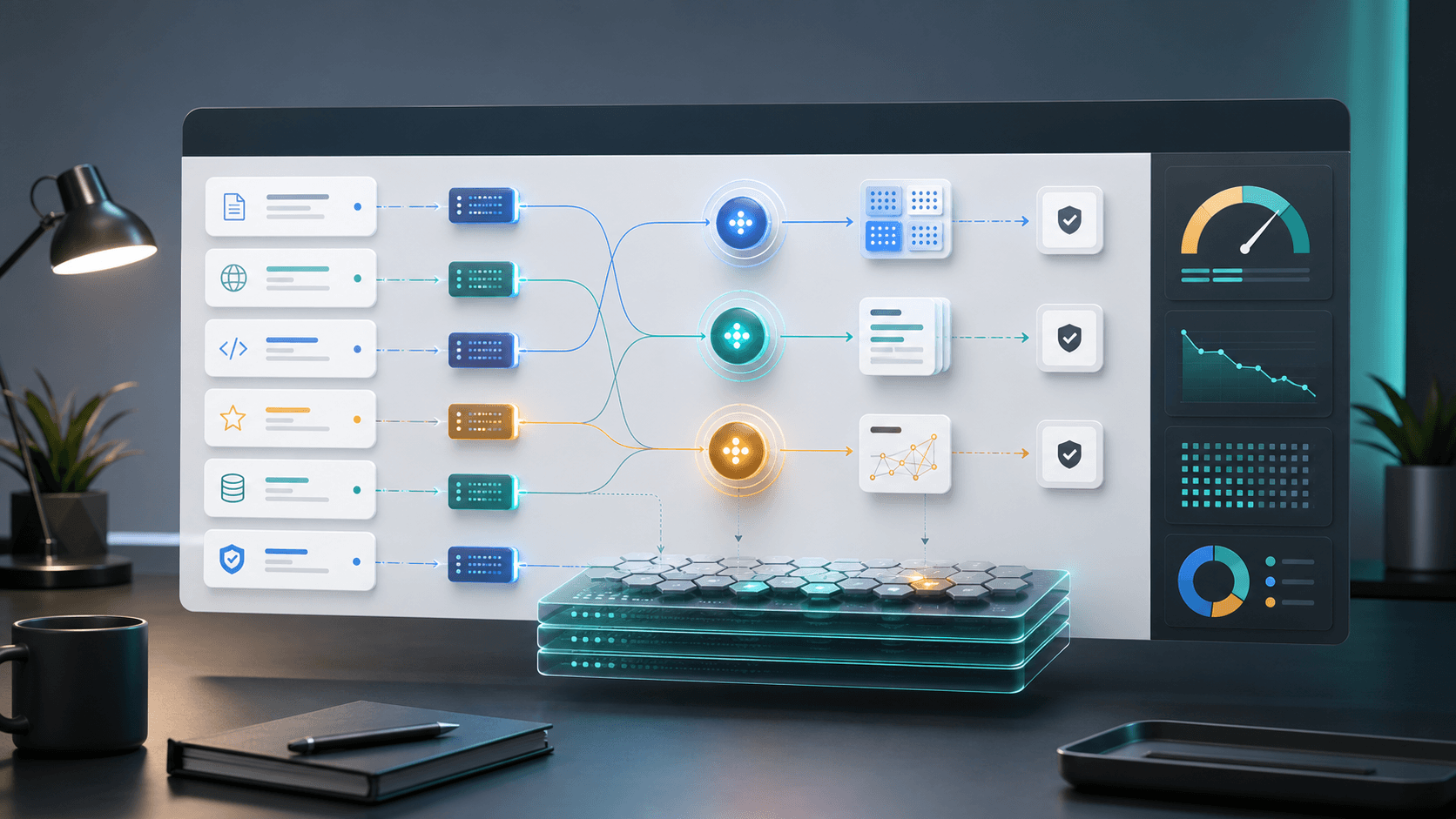
AI cost operations guide
The expensive part of AI adoption is not always the subscription price. It is the habit of sending the same background again, asking a premium model to do routine work, retrying vague prompts, and then paying a human to clean up unverified output. The practical fix is not model loyalty. It is a routing system: decide what kind of work this is, how much context it deserves, which source layer should answer first, and what proof is required before calling it done.
1. Overview: AI cost leaks through the operating system
Most teams start by asking which subscription to buy. That matters, but it is the second question. The first question is what we repeatedly ask AI to do, and why each request needs the most expensive layer.
OpenAI cost guidance points to a plain operating pattern: reduce unnecessary requests, reduce input and output tokens, and use smaller models where accuracy holds. Anthropic prompt-caching guidance says the same thing from another angle: if stable context repeats, make it reusable instead of paying to process it from scratch each time.
Community signals from the local X inbox were useful here. Builders complain about whole repositories being resent, PDFs being pasted repeatedly, expensive models being used for routine tasks, and human review time ballooning after unverified output. The exact social numbers are not treated as proof. The pain pattern is still useful.
2. Small dictionary: token, context, caching, RAG, routing
A token is a small piece of text the model reads or writes. Think of it as the unit that turns words into AI work. More input tokens and more output tokens usually mean more cost, more latency, and more irrelevant material for the model to sort through.
Context is the material sent with the task: instructions, files, previous messages, SOPs, examples, documents, tool results, and the current request. A long context window is a bigger desk, not a promise that every paper on the desk will be used correctly.
Prompt caching means reusing stable repeated prompt prefixes. RAG, or retrieval-augmented generation, means searching a knowledge base and attaching only the relevant source pieces. Routing means sending each task to the right layer: retrieval, small model, coding agent, premium reasoning model, or human review.
- Token: the billable work unit of reading and writing.
- Context: the material sent with the task.
- Prompt caching: reuse stable repeated prompt prefixes.
- RAG/retrieval: find the relevant source slice instead of pasting everything.
- Routing: a dispatch table that sends work to the right tool.
- Review cost: the human time spent checking, fixing, and proving the output.
3. The four leaks: repeated context, wrong model, retries, rework
Leak one is repeated context. The team sends the same policy, repo summary, PDF, examples, and tool definitions over and over. Prompt caching, source cards, and persistent notes exist because stable context should become infrastructure, not a fresh expense every time.
Leak two is wrong model choice. Premium models are valuable for architecture, ambiguous judgment, high-risk customer language, and final synthesis. They are usually the wrong default for simple extraction, formatting, linting, title variants, translation drafts, or one-line edits.
Leak three is duplicate attempts. Vague requests create three or four retries where a better task brief would have created one useful answer. Leak four is rework. If generated output fails tests, breaks style, misses sources, or does not survive live checks, the subscription cost is only the visible part. The hidden cost is senior review time.
4. Context budget: do not feed everything every time
The Lost in the Middle paper is a useful caution for operators. Long context helps, but models do not always use relevant information robustly when it sits inside a large input. In practice, paste everything is a fallback for exploration, not a recurring workflow.
For repeated work, create a context budget. Decide what must always be included, what should be retrieved only when relevant, what should be summarized once, and what should be left out unless the task specifically needs it. A PDF, repository, or company wiki should become source cards and retrieval snippets before it becomes a recurring prompt payload.
A practical rule: if the same material appears in more than three serious sessions, either cache it, turn it into a short operating note, or put it behind retrieval. The operator should not pay attention tax and token tax forever because the workflow never got packaged.
5. A routing table beats model loyalty
A routing table is a simple dispatch rule. It says which layer handles which kind of work. A small company can run it as a checklist in Notion, Obsidian, Google Sheets, or a repository note.
Start with five lanes. Retrieval lane: find and cite the relevant source. Routine lane: summarize, classify, format, translate, or transform low-risk text. Codex lane: change files, run lint/build, inspect diffs, and prove routes. Premium reasoning lane: handle architecture, unclear tradeoffs, high-risk language, and final synthesis. Human lane: approve irreversible actions and unresolved conflicts.
The point is not to worship one model. The point is to preserve expensive attention for places where it changes the outcome. If a cheaper layer can do the task with acceptable accuracy and verification, sending it to the premium layer is not quality. It is habit.
- Use retrieval first when the question is source-bound.
- Use smaller or cheaper models for repeatable low-risk transformations.
- Use Codex-style agents when work must touch files, run checks, and leave commit evidence.
- Use premium models for judgment, synthesis, ambiguity, and hard review.
- Use humans for irreversible actions, payments, publishing approval, legal judgment, and final risk acceptance.
6. Cache stable context, retrieve sources, verify completion
Prompt caching works best when reusable material stays identical. Put stable system instructions, role rules, SOPs, examples, schemas, and tool definitions first. Put the specific user request, date-sensitive facts, and one-off context after that.
OpenAI file search and the original RAG research point to the same practical idea: let the system retrieve relevant source pieces instead of forcing the model to read everything. The benefit is not only lower cost. It also gives reviewers a source trail.
Finally, count verification as part of the cost model. For public work, done means route check, image check, sitemap check, commit, push, and live URL confirmation. AI spending becomes controllable when the team can explain why this request needed this model, this much context, and this proof.
- Inventory the top ten recurring AI tasks.
- Mark each task as source-bound, routine transform, implementation, judgment, or approval.
- Set a context budget for each task.
- Move stable rules into cacheable prefixes or reusable operating cards.
- Use retrieval for large knowledge bases.
- Reserve premium models for high-value judgment and final synthesis.
- Count review and rework time as part of AI cost.
- Require evidence before publishing, shipping, or sending.
참고자료
- OpenAI API docs: Cost optimization
- OpenAI API docs: Prompt caching
- OpenAI API docs: File Search
- Anthropic Claude docs: Prompt caching
- Anthropic: Effective context engineering for AI agents
- Retrieval-Augmented Generation for Knowledge-Intensive NLP Tasks
- Lost in the Middle: How Language Models Use Long Contexts
- X: AI coding bill and router signal
- X: PDF token waste and NotebookLM middle-layer signal
- X: Codex planner and smaller expert-model signal
- X: AI output rework-cost signal
Turn AI spend into a routing system
Guildex Fit Check maps one recurring workflow into task lanes, source cards, context budgets, model routing, review gates, and completion evidence so AI subscriptions become operating leverage instead of background leakage.