How to stop AI from repeating the same mistake
An AI agent mistake is not only a prompt problem. Repeated mistakes need an operating loop: incident log, root-cause analysis, checklist and SOP update, eval case, trace review, and live verification.
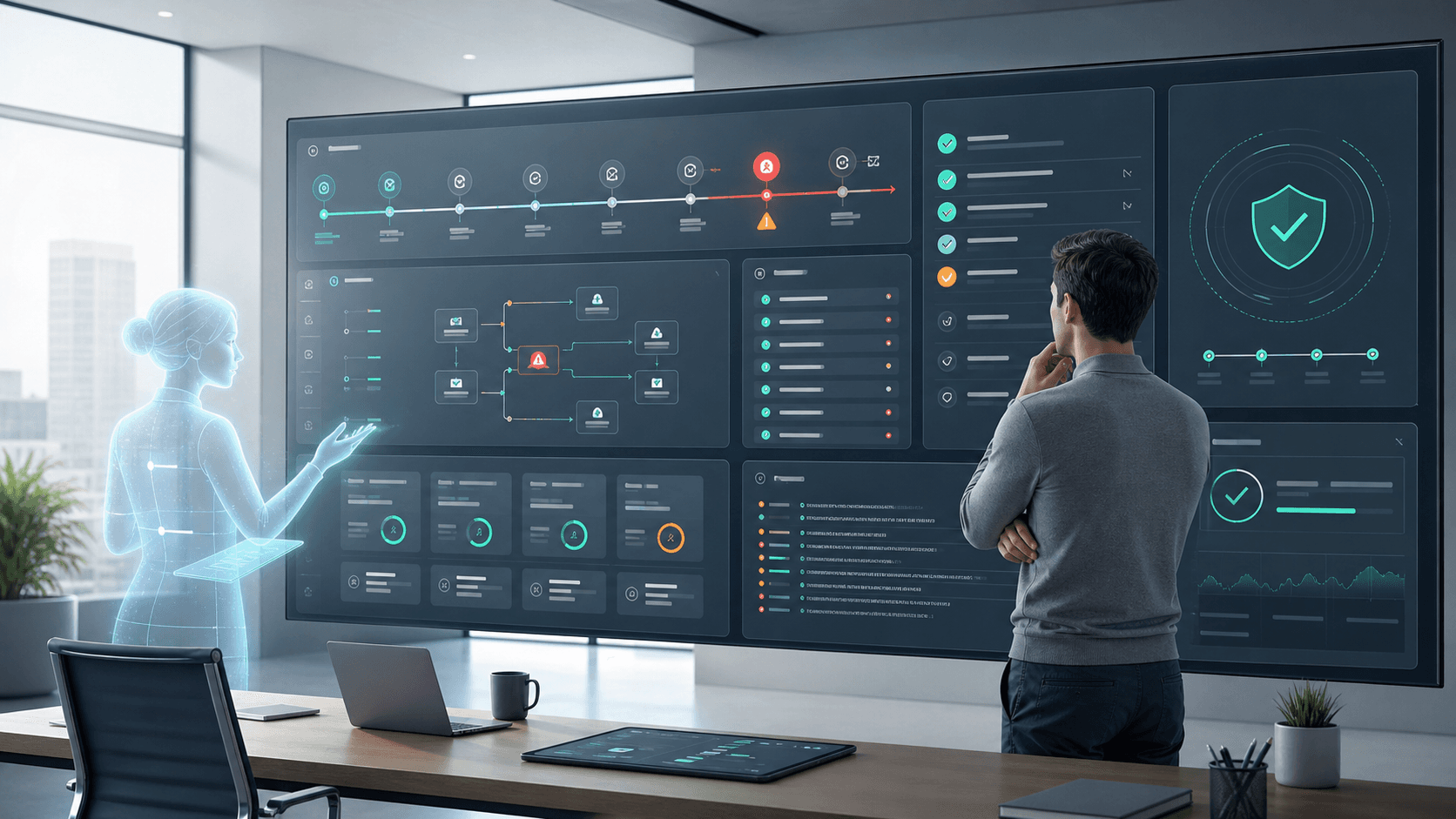
AI incident learning guide
One AI mistake can be a normal incident. The same mistake twice is usually a system problem. The fix is not a louder prompt or a better memory trick. The fix is a learning loop that turns every miss into an incident record, a root-cause note, a checklist gate, an eval case, and a real-world verification step.
1. Overview: a repeated mistake is a system problem
AI agents are now being connected to files, tools, websites, inboxes, CRMs, and internal knowledge. That makes them more useful, but it also changes what a mistake means. A wrong answer in a chat is annoying. A wrong step inside a workflow can become a customer, publishing, finance, or compliance problem.
The practical question is not whether the agent will ever make a mistake. It will. The question is whether the organization becomes smarter after the mistake. If the team only says "be careful next time", the same failure can return under a slightly different shape.
A publishing workflow gives a clean example. A local file, a local preview, or even a local commit does not prove that readers can see the post. Completion requires the pushed remote, live localized URLs, the image, and the sitemap. If that closeout rule is missing from the checklist, the agent can honestly do a lot of work and still leave the public surface unchanged.
2. Small dictionary: incident log, root cause, checklist, eval, trace, SOP
Incident Log means a simple record of a work accident or near miss. It is not only for server outages. If an agent sent the wrong draft, used an old policy, skipped a live check, or repeated a bad assumption, that belongs in the log.
Root Cause, often called RCA, means looking for the condition that allowed the mistake to happen. It is not a blame exercise. The answer should sound like "the checklist did not define live verification", not "someone forgot".
Checklist is a small execution table that protects the team from memory. SOP means standard operating procedure, a written way to handle a repeated task. Eval means a test set that checks whether the agent behaves correctly on examples that matter. Trace or log means the run history: what the agent read, which tool it called, what decision it made, and where the output went.
- Incident Log: the record of what went wrong, when, where, and with what impact.
- Root Cause: the system condition that made the mistake possible.
- Checklist: the minimum gates that must be checked before calling the work complete.
- Eval: a repeatable test for the behavior the team wants the agent to keep.
- Trace or Log: the evidence trail of an agent run.
- SOP or Runbook: the written operating path for the next similar case.
3. The repeat-mistake loop
A useful loop has six moves. Run the workflow. Record the incident. Find the root cause. Update the checklist or SOP. Add an eval case. Verify the next real run on the surface that matters. For a blog, that surface is the live URL and sitemap. For support, it may be the ticket state and customer-visible draft. For finance, it may be the approved ledger entry.
OpenAI and Anthropic both emphasize evals because reliable AI work needs testable behavior. Google SRE and Atlassian incident practices add the missing operations lesson: the team has to convert failure into prevention work instead of relying on heroic attention.
This also explains why "AI memory" alone is not enough. A memory can remind the agent. A checklist gate blocks completion. An eval catches recurrence. A trace shows why the run drifted. These are different layers, and reliable operations need more than one layer.
- Run: perform the workflow with visible inputs and outputs.
- Record: capture the miss in a structured incident log.
- Analyze: name the root cause without blaming a person.
- Change: update the checklist, SOP, prompt, permission, or source rule.
- Test: add an eval or regression case for the failure.
- Verify: check the real external result before closing the task.
4. What to record in the incident log
The log should be boring and precise. It does not need a heavy incident-management platform. A table in Notion, Google Sheets, GitHub, or Obsidian is enough if the fields are consistent.
The fields should let a future reviewer understand the mistake without re-running the whole conversation. What was the expected result? What actually happened? Which source, tool, or route was involved? Which completion signal was missing? What was the prevention change?
- Date and workflow: when it happened and which workflow was affected.
- Expected result and actual result: the simplest before-and-after description.
- Detection signal: how the team noticed the issue.
- Impact: customer-visible, internal-only, money, data, brand, or compliance.
- Trace or evidence: URLs, logs, screenshots, tool output, commits, or tickets.
- Root cause: the process condition that allowed the miss.
- Prevention: checklist, SOP, eval, guardrail, owner, or permission change.
- Closeout proof: the live URL, test result, deployment, or approval that proves the fix reached reality.
5. Root cause without blame
Blameless does not mean consequence-free or vague. It means the team looks for the repeatable condition. "The agent forgot to push" is a weak root cause. "The definition of done stopped at local verification and did not require remote plus live checks" is useful because it can become a gate.
Good root-cause analysis usually points to one of a few buckets: unclear source of truth, missing owner, stale context, weak permission boundary, no external verification, ambiguous approval rule, no eval case, or no trace of what happened.
This is the moment where people improve alongside AI. Humans stop being passive approvers and become workflow designers. They learn to ask better questions: what signal would have caught this earlier, which gate was missing, and what should the agent be unable to call complete next time?
6. Checklists should define completion, not intention
A checklist should not say "publish post". That is too vague. It should say: add localized post data, add image, run type check, run lint, run build, verify localized routes, verify list pages, verify sitemap, commit, push, and confirm live URLs. The point is to make the last mile visible.
For other workflows, completion may mean something different. A sales summary is not complete until it is attached to the CRM record. A support draft is not complete until a human reviewer approves it. A data cleanup is not complete until the downstream report changes as expected.
The strongest checklists contain external proof. "File edited" is weaker than "live page returns 200 and contains the new slug". "Draft generated" is weaker than "reviewer approved and customer-send is still blocked".
7. Evals turn incidents into repeatable tests
Eval is a technical word, but the idea is simple: build a small set of examples that the agent must handle correctly. If a workflow failed because it trusted stale knowledge, add an example with stale and current sources. If it skipped live verification, add a case where local success is not enough.
Do not start with a giant benchmark. Start with ten failures the company actually cares about. Include the expected answer, forbidden behavior, required citation, required approval, and proof of completion. Then run that set whenever the prompt, model, tool, source, or checklist changes.
Community signals around agent operations keep pointing to domain-specific failures. A generic model judge can miss the exact thing your company cares about. That is why the best eval cases come from real incidents, customer corrections, reviewer edits, and near misses.
8. The Guildex incident-learning table
For a small team, the most useful artifact is a single table that connects the incident to the next prevention layer. The goal is not bureaucracy. The goal is to make the system remember what the team learned.
A practical row looks like this: "Post exists locally but not live" as the incident, "live blog still shows old newest post" as the detection signal, "definition of done did not include push and live sitemap check" as the root cause, "add commit, push, live URL, image, and sitemap checks to the checklist" as prevention, and "live URLs return 200" as closeout proof.
- Incident: what went wrong in plain language.
- Signal: how the miss was detected.
- Root cause: the missing system condition.
- Prevention: which checklist, SOP, eval, permission, or source rule changed.
- Owner: who maintains that prevention layer.
- Verification URL or output: the external proof that the task is truly closed.
9. Conclusion: AI adoption compounds when mistakes become knowledge
The companies that benefit from AI will not be the ones that never see mistakes. They will be the ones that convert mistakes into better operating knowledge. Every incident should leave the system harder to fool, easier to review, and clearer about what "done" means.
As AI improves, people have to improve too. The human role moves from "check this output quickly" to "design the loop that makes the next output safer". That means better incident logs, better root-cause thinking, better checklists, better evals, and better live verification. AI speed becomes useful only when the human operating system learns at the same time.
참고자료
- OpenAI API docs: Evals
- OpenAI Agents SDK: Tracing
- OpenAI API docs: Agents
- Anthropic docs: Evaluation tool
- Anthropic: Effective context engineering for AI agents
- Google SRE: Postmortem culture
- Atlassian: Incident postmortem
- NIST AI Risk Management Framework
- OpenTelemetry: Traces
- Reddit r/AI_Agents: validation and provenance signal
- X: repeated mistake prevention signal
- X: state verification signal
- X: domain-specific eval signal
- X: SkillOpt and procedural improvement signal
Turn agent mistakes into operating improvements
Guildex Fit Check maps one workflow into incident logs, root causes, checklist gates, eval cases, owners, and live verification steps so repeated AI mistakes become preventable operating knowledge.