What a personal AI work assistant needs to run reliably
A useful personal AI agent is not just a smarter chat box. It needs an operating wrapper: a messenger interface, runtime, source-of-truth knowledge, MCP tools, reusable skills, approvals, logs, healthchecks, and a failure-learning loop.
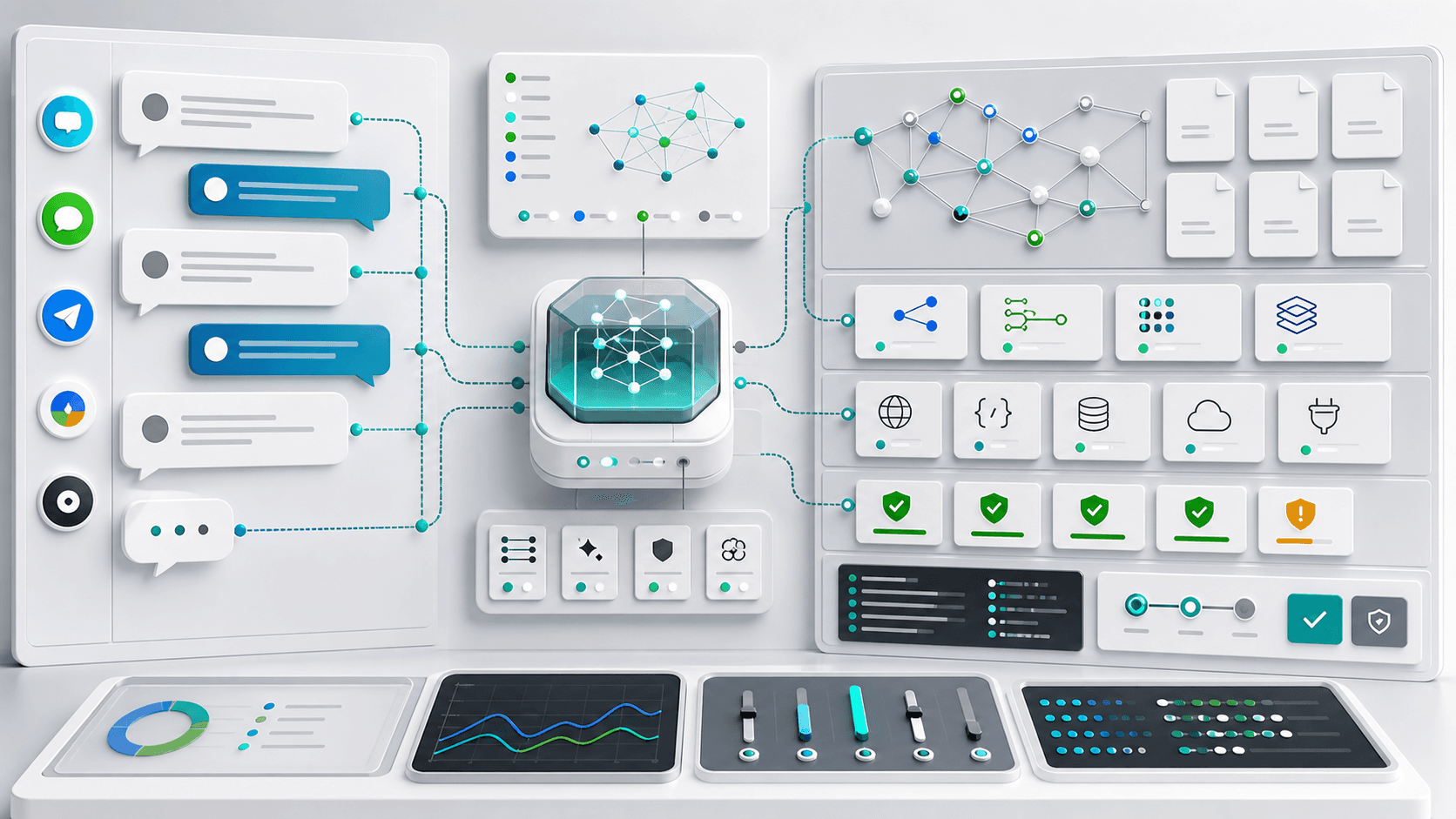
AI agent operations guide
Hermes is interesting because it changes the question. Instead of asking which model writes the best answer in a chat window, it asks what must surround the model before it can behave like a real work assistant. The answer is an operating wrapper: a way to send requests from anywhere, read the right knowledge, call the right tools, remember stable rules, ask for approval, prove that it is connected, and learn from failure.
1. Overview: an agent is not a bigger chat window
Most people meet AI through a chat box, so they naturally judge agents by the answer on screen. That is too narrow. A work assistant has to receive requests, know the company context, use tools, follow standing rules, escalate risky actions, leave evidence, and be reachable when the human is not sitting at the desk.
That is why Hermes is a useful case study. The important part is not a secret model trick. The interesting part is the wrapper around the model: Telegram as the request door, a local runtime, a Codex-style provider, Obsidian as a knowledge surface, MCP as the tool/data connector, skills as reusable procedures, and healthchecks as proof that the system is alive.
The official sources point the same way. OpenAI describes agent apps as systems that plan, call tools, keep state, use approvals, and need observability. MCP docs describe a standard way to connect AI applications to external systems, while also emphasizing human confirmation and logs for sensitive tool use. The field signal from X matches the same direction: builders are moving from "write a better prompt" to "put AI inside an operating system."
2. Small dictionary: gateway, runtime, MCP, skill, memory, healthcheck
A gateway is the door between the human and the agent. In Hermes, Telegram plays that role. In plain language, it means you can send a work request from your phone instead of opening a coding app or a dashboard.
Runtime means the place and process where the agent actually runs. Provider means the model or agent backend that does the reasoning and execution. MCP, or Model Context Protocol, is a standardized socket for connecting AI to data, tools, and workflows. It is not the brain; it is the connector.
A skill is a reusable work recipe. Memory is stable context the agent can carry across sessions. A healthcheck is a repeatable test that proves the important pieces are connected. A failure packet is a small incident note: what failed, what signal showed it, why it happened, and what rule prevents the same failure next time.
- Gateway: the door where requests arrive.
- Runtime: the machine or process where the agent runs.
- Provider: the model or backend doing the reasoning.
- MCP: a standard connector for tools, files, APIs, and workflows.
- Skill: a reusable procedure for a recurring task.
- Memory: stable context that should not be re-explained every session.
- Healthcheck: a repeatable proof that the system is connected.
- Failure packet: a short postmortem that turns mistakes into future rules.
3. Why the messenger interface matters
A messenger interface looks almost too simple, but it solves a real adoption problem. The best automation is useless if the request has to wait until you are at the right computer, in the right repo, with the right terminal open. Telegram turns the agent into an always-near input surface.
The business value is not "chat from anywhere" as a novelty. It is capture speed. A founder can forward a customer issue, a team lead can ask for a source-backed summary, and an operator can request a daily check without reopening the whole work environment.
But this door must be narrow. A messenger should be excellent for reading, drafting, summarizing, triaging, and queueing. It should not silently delete files, send customer messages, move money, or change production systems. The moment the gateway can trigger real side effects, approvals and logs become part of the product, not an optional safety note.
4. Knowledge base: the agent needs a source of truth, not a pile of notes
The most common failure mode is a confident answer from stale or partial context. Obsidian is powerful because it can hold durable company knowledge in plain notes: decisions, SOPs, source links, project rules, research logs, and daily context. The Obsidian Local REST API shows one implementation pattern: expose the vault through authenticated REST and MCP so an AI agent can read, search, and, when allowed, patch notes.
The key phrase is "when allowed." A knowledge base connected to an agent is not automatically safe. The first operating rule should be read/search/list first. Write, append, patch, move, or delete should require an explicit target and a reason. This is where MCP is useful but also dangerous: it makes tools accessible, so the permission boundary must become visible.
Anthropic calls this broader discipline context engineering: putting the right context in front of the model at the right moment. For a small company, that does not require a giant knowledge graph on day one. It requires one workflow card with owner, updated date, source links, examples, exceptions, approval rules, and forbidden actions.
5. Skills and memory: stop re-explaining the same work
The X inbox kept repeating one practical pain: people are tired of saying the same thing to AI every session. Tone, project constraints, preferred workflow, forbidden actions, and source priorities should not live only in today's chat. They should become project rules, memory files, and skills.
A skill is not magic. It is a reusable playbook for a recurring job: how to research a blog post, how to run a route check, how to review a risky git command, how to prepare a customer reply, how to triage a launch issue. When the procedure is written down, the agent can load it when needed instead of carrying every detail in the always-on prompt.
Memory needs the same restraint. Permanent memory should hold durable facts and preferences, not every temporary thought. The better pattern is layered: a small always-loaded briefing, on-demand skills for detailed procedures, and source notes that can be searched when the task needs evidence.
6. Approvals and tool boundaries: connect less, prove more
The wrong way to build an agent is to connect every tool and call it productivity. More tools increase capability, but they also increase the chance of accidental data exposure, wrong writes, and unclear responsibility. MCP's own tool specification says sensitive operations need human confirmation, clear indicators, input validation, timeouts, and audit logs.
OpenAI Codex approval and sandbox documentation points to the same operational shape: read and edit inside a controlled workspace, ask for approval when crossing boundaries, and treat destructive or side-effecting tool calls with extra care. This is not bureaucracy. It is how the human stays accountable while the agent gets more useful.
A good Hermes-style wrapper therefore starts with a whitelist: what can the messenger trigger, what can the agent read, which tools are read-only, which actions require approval, which actions are forbidden, and where evidence is written after the run.
7. Healthchecks, logs, and failure packets
If an agent is part of operations, "it worked yesterday" is not enough. The gateway can disconnect. OAuth can expire. Obsidian can be closed. A local MCP endpoint can fail. A startup entry can break. A model/provider setting can change. Without a healthcheck, the first person to discover the failure may be the person waiting for work that never arrives.
A healthcheck should be boring and repeatable: is the gateway process running, can it reach the provider, can it reach the knowledge source, can it list tools, can it complete a harmless test request, and are logs being written? This is the difference between a demo and a working assistant.
The second loop is the failure packet. When the same failure repeats, do not only fix it manually. Record the incident, signal, root cause, prevention rule, and closeout proof. That turns a fragile personal script into a system that improves every week.
8. How a company should adopt this without overbuilding
For a small team, the first Hermes-style agent should not manage the whole company. Pick one recurring workflow with low downside and clear sources: daily knowledge digest, customer-question triage, lead research, launch checklist review, blog research brief, or internal SOP lookup.
Then build the smallest operating wrapper around it. One messenger entry point, one source-of-truth folder, one task ticket format, one or two read-first tools, one approval rule, one healthcheck, and one place where results are logged. If that works for two weeks, add one more tool or one more workflow.
This is also where the human grows with the AI. As models become better, the human advantage shifts from typing every answer to designing the work system: source priority, permission boundary, escalation rule, quality bar, and feedback loop. The person who can operate agents well becomes more valuable, not less.
참고자료
- OpenAI API docs: Agents SDK
- OpenAI Codex docs: Prompting Codex
- OpenAI Codex docs: Agent approvals and security
- Anthropic: Effective context engineering for AI agents
- Model Context Protocol: What is MCP?
- Model Context Protocol specification: Tools
- Telegram Bot API
- Obsidian Local REST API with MCP
- NIST AI Risk Management Framework
- X: Hermes, Telegram, memory, and SOUL.md agent infrastructure signal
- X: CLAUDE.md and Obsidian context-repeat bottleneck signal
- X: Tool Calling, MCP, and Skills as different layers signal
- X: Obsidian hot cache, save, autoresearch, and stale-knowledge dashboard signal
- X: agent harness needs tools, memory, permissions, coordination, and observability signal
Turn one AI assistant into an operating wrapper
Guildex Fit Check helps teams choose one recurring workflow and design the messenger entry point, source-of-truth card, tool boundary, approval rule, healthcheck, and learning loop before they connect AI to more of the business.