How to keep AI from trusting stale company knowledge
Company knowledge becomes risky when an AI agent can retrieve it but cannot tell whether it is current, authoritative, or contradicted by a newer source. Design source-of-truth, freshness, conflict, and escalation rules before scaling agent access.
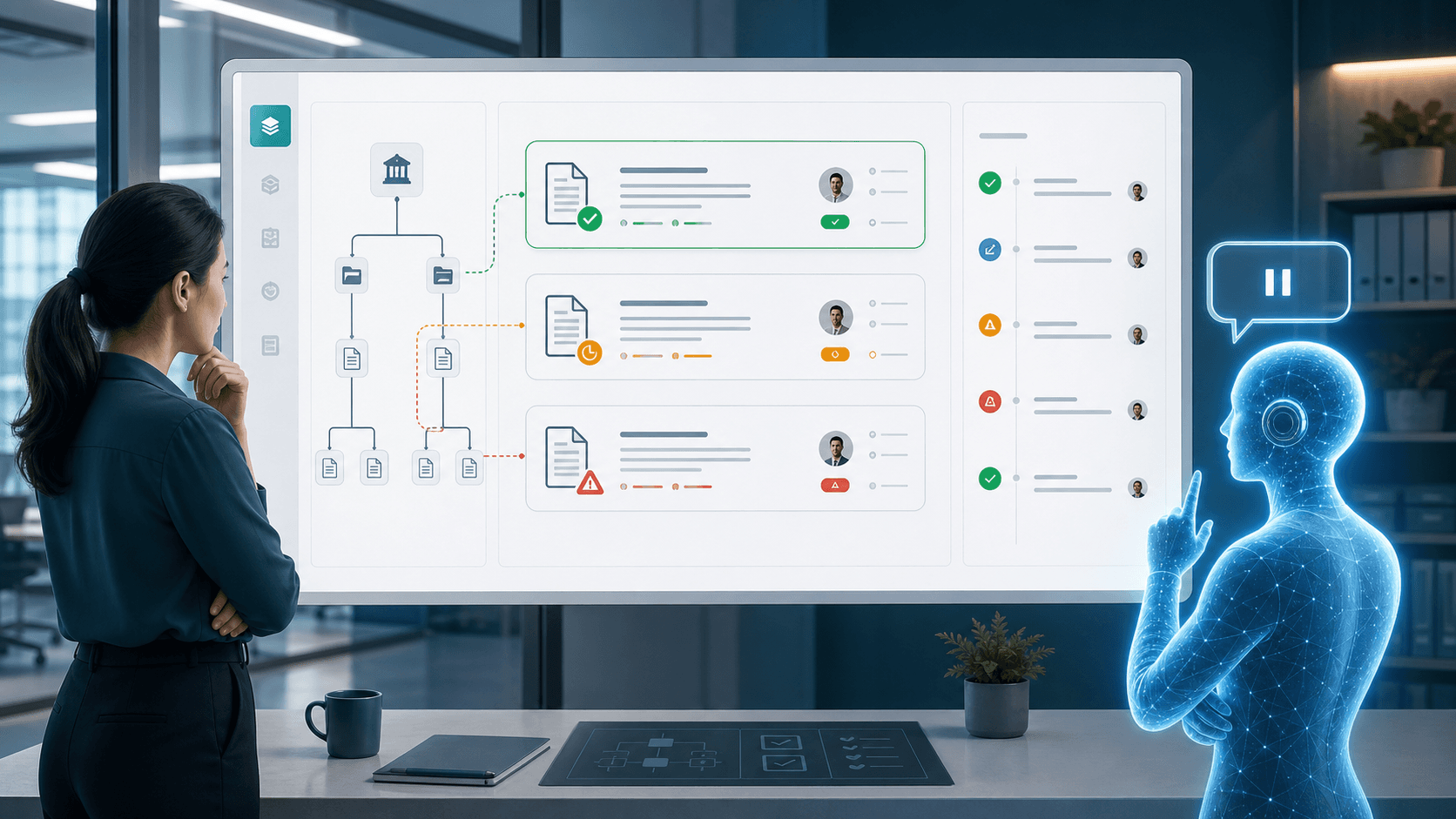
AI knowledge governance guide
The dangerous AI knowledge problem is not only hallucination. It is a confident answer from a document that used to be true. Once an agent can search company files, the team needs a practical answer to four questions: which source wins, how fresh is it, what happens when sources conflict, and who updates the rule after reality changes.
1. Overview: stale truth is more dangerous than no knowledge
Many teams worry that an AI agent will make something up. That is real. But in company operations, a quieter failure can be worse: the agent finds a real document, uses it correctly, and still gives the wrong answer because the document is old, superseded, or only a draft.
Retrieval tools make company knowledge easier to use. OpenAI file search, Microsoft Copilot Studio knowledge sources, Google grounding, and similar systems can connect models to documents and data sources. That is useful infrastructure. It does not decide which document is the final rule when three sources disagree.
A simple publishing example makes the point. If a blog post exists in a local repository but the live site still shows the older post list, the local file is not enough. The source of truth for readers is the deployed site, the live URL, and the sitemap. Company AI needs the same discipline: do not call something done until the real operating surface proves it.
2. Small dictionary: source of truth, freshness, RAG, grounding, MCP
Source of Truth means the place the team agrees to treat as final. In plain language, it is the document, database, or system that wins when other notes disagree. A refund policy page may beat a meeting note. A signed contract may beat a sales memo. A CRM status may beat an old spreadsheet.
Freshness means whether the rule is still current. It is not just a date. It is a combination of last reviewed date, owner, update trigger, and expiry rule. A policy last reviewed yesterday by the owner is stronger than a wiki page nobody has touched for a year.
RAG means retrieval-augmented generation. The AI searches relevant knowledge before answering. Grounding means the answer is tied to retrieved sources. MCP, or Model Context Protocol, is like a standard plug that lets AI tools connect to outside systems. These are powerful, but they do not replace source priority, freshness checks, or escalation rules.
- Source of Truth: the rule that wins when documents disagree.
- Freshness: the signal that a rule is still current and owned.
- RAG: search company knowledge before answering.
- Grounding: tie the answer to retrieved evidence.
- MCP: a tool-connection standard, not a guarantee that the connected data is correct.
3. Why document count is the wrong metric
A large knowledge base can look mature while being operationally fragile. Old proposals, meeting notes, onboarding pages, Slack summaries, Notion pages, and exported PDFs often contain overlapping rules. An agent that can search all of them may find more text without finding the current answer.
The original RAG idea is valuable because retrieved external knowledge can ground generation. The "Lost in the Middle" research is the useful caution: adding more context does not guarantee the model uses the right information well. In practice, the team has to design smaller, authoritative retrieval units.
Community signals from Reddit and AI-agent builders keep pointing to the same pain: context selection, provenance, and trust matter as much as model quality. Treat those threads as social signal, not proof. The operational conclusion is still practical: fewer current sources with clear ownership beat a giant bucket of historical documents.
4. Source priority: decide which source wins before the agent reads
Source priority should be written before connecting tools. For a customer workflow, the order might be signed contract, current public policy, internal SOP, CRM status, approved template, then meeting note. For finance, it might be accounting system, invoice, bank record, then spreadsheet. The exact order depends on the company, but the order must exist.
This protects the agent from a common trap. A meeting note may say "we are thinking about changing the refund rule." A policy page may say "refunds require approval above this amount." Without priority, the agent may blend both into a plausible but unofficial answer.
- Write the source hierarchy for each workflow.
- Mark drafts and meeting notes as background, not final rules.
- Keep customer-facing promises below signed contracts and current policy.
- Make the agent cite the source tier it used.
- If the top-tier source is missing, require escalation.
5. Freshness: owner, last reviewed date, expiry, and update trigger
Freshness needs four fields. Owner says who maintains the rule. Last reviewed says when a human checked it. Review cadence says how often it should be checked. Update trigger says what event forces a review, such as a price change, contract change, policy change, new legal requirement, or repeated reviewer correction.
This is where many AI knowledge bases silently decay. The agent keeps retrieving the page because it is semantically relevant, not because it is still true. A stale but well-written page can be more dangerous than an empty result because the answer feels official.
NIST AI risk guidance is useful here because it frames AI risk as a lifecycle and organizational management problem. For a small company, the practical version is simple: every important knowledge asset needs an owner and a review loop.
6. Conflict rules: the agent should pause instead of guessing
The most valuable behavior is sometimes refusal to answer. If the agent finds two high-relevance sources that disagree, it should show the conflict, cite both, and ask a human owner to resolve it. A confident synthesis is the wrong behavior when the inputs are contradictory.
A good conflict response says: "I found two rules that appear to disagree. The current policy page says this. The newer meeting decision says that. I cannot decide which one is authoritative. Please confirm the source of truth." That pause prevents the agent from turning internal ambiguity into external damage.
- Detect same-topic sources with different rules, thresholds, dates, or owners.
- Prefer the highest source tier only when it is fresh enough.
- When freshness or authority is unclear, cite and escalate.
- Turn each resolved conflict into an updated SOP and eval case.
7. The Guildex knowledge-readiness checklist
Before giving an agent access to company knowledge, build a small knowledge control sheet for one workflow. It does not need a large platform. A table in Notion, Google Sheets, GitHub, or Obsidian can be enough if the fields are enforced.
The checklist should be visible to the person reviewing agent outputs. The reviewer should not need to guess whether the agent used a current rule or an old note.
- Workflow: which task this knowledge supports.
- Allowed sources: what the agent may retrieve.
- Source priority: which source wins when sources disagree.
- Owner: who maintains each rule.
- Freshness: last reviewed date, review cadence, and expiry trigger.
- Citation rule: when the agent must show sources.
- Conflict rule: when the agent must stop and escalate.
- Eval cases: examples that test source priority, freshness, and conflict handling.
8. Conclusion: knowledge access is a maintenance system
AI adoption does not become reliable just because the agent can read more. It becomes reliable when the team knows which source wins, which rule is current, who owns it, and what the agent must do when the knowledge is unclear.
Treat the knowledge base as a maintenance system, not a storage folder. Start with one workflow. Write the source hierarchy, freshness rule, conflict behavior, owner, and eval cases. Then let the agent read. That order prevents a helpful demo from becoming an expensive repeated mistake.
참고자료
- OpenAI API docs: File Search
- OpenAI API docs: Agents
- Anthropic: Effective context engineering for AI agents
- Microsoft Learn: Knowledge sources in Copilot Studio
- Google Cloud: Grounding with your data
- NIST AI Risk Management Framework
- Retrieval-Augmented Generation for Knowledge-Intensive NLP Tasks
- Lost in the Middle: How Language Models Use Long Contexts
- Reddit r/AI_Agents: provenance and validation signal
- X: markdown company OS and MCP signal
- X: persistent AI briefing and CLAUDE.md signal
- X: local company knowledge graph signal
Make the source of truth clear before the agent reads
Guildex Fit Check maps one workflow into allowed sources, source priority, freshness rules, conflict behavior, owner, citations, approval boundaries, and eval cases before AI access expands.