What gets better when AI can read company knowledge?
AI agents become useful at work when they can safely read SOPs, meeting notes, customer history, policies, and past decisions. The real work is deciding access, sources, logs, and cloud/local boundaries before automation.
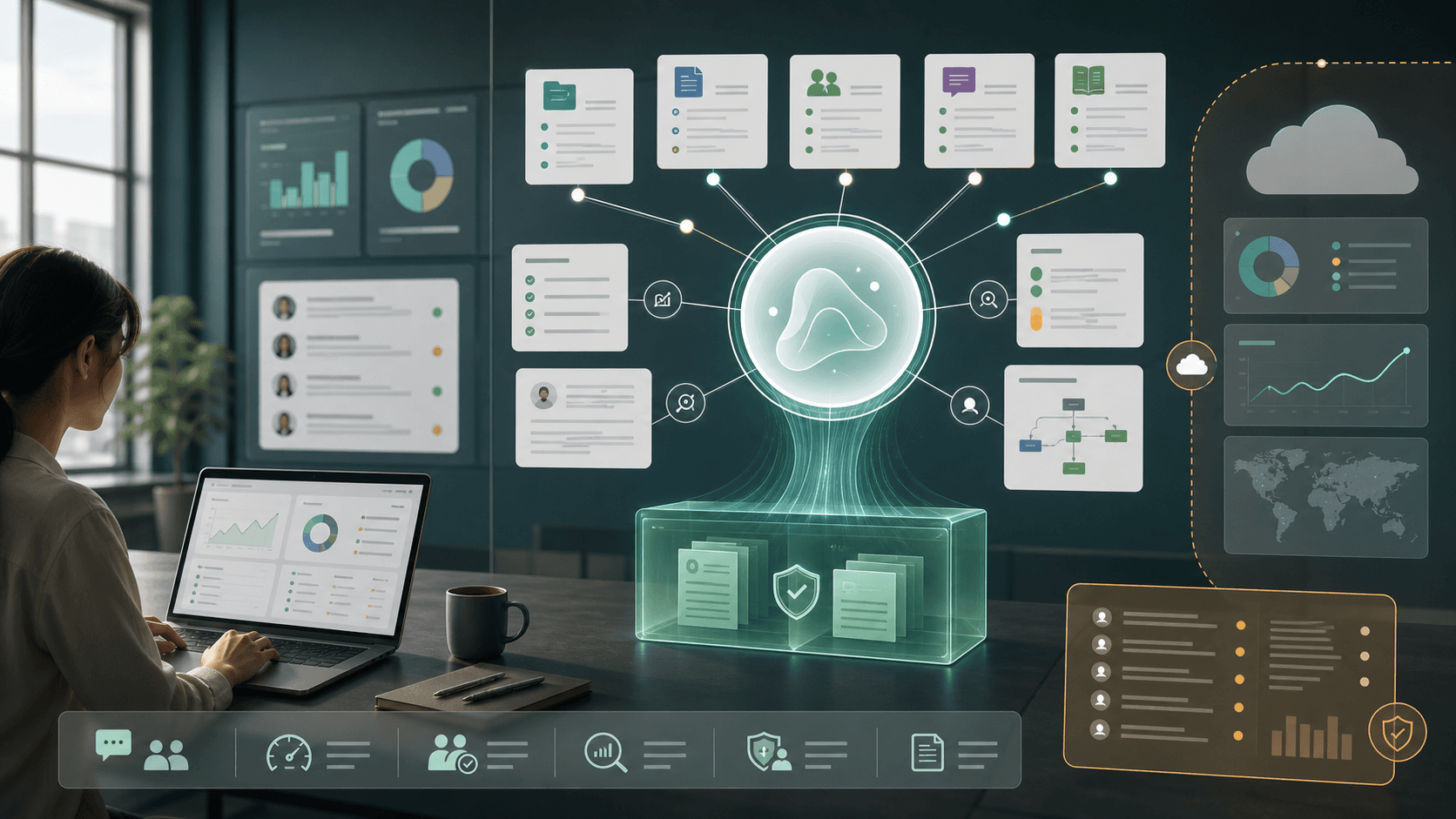
Company knowledge access guide
Even a capable AI agent behaves like a new hire when it does not know the company context. You have to explain the product, policies, exceptions, internal vocabulary, and past decisions again and again. Once the agent can safely read company knowledge, it becomes less of a generic chatbot and more of an interface to company memory.
1. Overview: agents become work tools when they can use company memory
The social signal behind this topic was clear: people want AI systems that remember work context, but they are uneasy about sending all mail, meeting notes, and internal documents to cloud tools. That is why local execution, Obsidian, knowledge graphs, MCP, and private RAG keep appearing together.
Official guidance points in the same direction. Notion frames enterprise search around connected tools and existing permissions. OpenAI and Anthropic describe useful agents as systems made from instructions, tools, retrieval, and guardrails, not just a model in a chat box.
Without company knowledge, AI speaks in generalities. With the right knowledge, it can answer from the company policy, customer history, meeting decisions, and current SOPs. That difference is where most of the operational value appears.
2. Benefit: fewer repeated explanations
Many teams hit the same wall after the first excitement fades. Every session needs the same brand tone, product structure, pricing policy, customer type, banned phrases, and approval rule. This is not only a prompt-writing problem. It is a company-memory problem.
When an agent can read company knowledge, support drafts can reference the product guide, refund policy, recent announcements, similar past tickets, and manager approval rules without a person pasting them every time.
The gain compounds at the organization level. A clever prompt stays with one person, but a shared knowledge base can be reused by the next employee, the next agent, and the next workflow.
- Teams stop pasting the same product, policy, and exception notes into every session.
- New employees and contractors can catch up through meeting notes and SOPs faster.
- The team shifts from prompt tricks to shared operating standards.
- The agent answers from company context instead of default internet generalities.
3. Benefit: answers become grounded in policy and customer context
RAG research supports the basic idea: do not rely only on the model memory. Retrieve relevant external knowledge and use it when generating the answer. In company work, that means current documents, customer records, approval rules, and past decisions.
A refund question cannot be answered from a generic rule alone. The agent may need the order date, product type, customer tier, prior compensation, inventory status, recent announcement, and an exception note from the owner. With those inputs, the human reviewer can focus on judgment rather than lookup.
But dumping more documents into a long prompt does not solve the problem. The Lost in the Middle paper is a useful warning: long contexts can still hide important information. Retrieval units, source labels, freshness, conflict detection, and permission filters matter more than raw document volume.
- Every answer can show which document, meeting note, or customer record was used.
- When policy changes, the source can be updated instead of rewriting prompts.
- Reviewers can inspect evidence rather than arguing with a polished answer.
- Small searchable units are safer than one giant context dump.
4. Benefit: onboarding and handoffs get faster
Small companies often lose the most valuable knowledge in scattered context: why a policy exists, why one customer is an exception, which phrase should not be used, and who needs to approve a specific action.
A knowledge-aware agent changes onboarding questions. Instead of only asking where the refund policy is, a new teammate can ask why the policy changed, how a current case differs from a previous one, and who approved the last exception.
This does not replace experienced people. It reduces the amount of background they have to repeat, so people spend more time on judgment and less time on basic context transfer.
- New people learn internal terms, customer types, and policies faster.
- Past decisions remain searchable when a role changes hands.
- Meeting notes and work logs become material for the next execution.
- Humans handle the judgment-heavy questions instead of every repeated explanation.
5. Benefit: the agent can detect patterns across scattered signals
The deeper value is not only better answers. It is pattern discovery. If support tickets, refund reasons, sales calls, meeting notes, and product changes are connected, the company can ask what is causing repeated issues, not just how many tickets arrived this week.
An agent can compare signals across channels and propose likely causes. Shipping complaints may point to inventory copy, a detail-page phrase, a courier issue, or an internal approval delay. The point is not to automate blame, but to surface better improvement candidates.
For Guildex, AI adoption should be measured by the improvement loop: better SOPs, better FAQs, cleaner approval rules, and clearer boundaries for what should and should not be automated.
- Repeated issues can be grouped by product, policy, page copy, or internal process.
- Human edits to AI drafts can feed the next SOP update.
- Meeting decisions can be checked against later customer outcomes.
- The team can separate stable automation zones from areas that still need human judgment.
6. First boundary: decide what the agent can read
The benefits are large, so the boundary must be explicit. OWASP highlights prompt injection and sensitive information disclosure as LLM application risks. NIST AI RMF frames AI risk as an organizational design and operations problem, not only a model-quality problem.
The first question is not whether to upload all documents. It is which knowledge is needed for which workflow, under which permission, with which source labels and logs.
A practical split is four tiers: open operating knowledge, role-restricted working knowledge, sensitive knowledge that needs approval, and forbidden knowledge that agents should not read at all.
- Open knowledge: product descriptions, public FAQs, basic SOPs, public pricing.
- Restricted knowledge: customer history, internal meeting notes, channel logs, owner comments.
- Approval knowledge: contracts, high-value refunds, legal issues, sensitive customer records.
- Forbidden knowledge: passwords, raw payment data, unnecessary personal data, employee-sensitive information.
7. Cloud, local, or hybrid
The common community concern is whether company data should be sent to cloud AI tools. There is no single answer. Public documents and general SOPs may be fine in managed SaaS. Contracts, sensitive meeting notes, and detailed customer records may belong in a local or restricted environment.
Local systems provide control, but they add operational burden: model updates, retrieval quality, permissions, backups, and performance. Cloud systems improve connectivity and management, but require careful review of data handling, retention, access control, and audit logs.
Most companies should start hybrid and read-only. Let the agent find and summarize sources first. Keep edits, customer messages, payments, and policy changes behind human approval until trust is earned.
8. Rollout order
Start with one repeated workflow: customer support, quote requests, new employee onboarding, or weekly meeting summaries. List the knowledge people repeatedly explain, the documents they search, the decisions they reference, and the data the agent must never see.
Then test retrieval quality. Require citations, freshness checks, conflict warnings, and honest uncertainty. Review the source trail, not only the fluency of the answer.
As AI improves, people must improve too. The human role moves from manual document search to knowledge-boundary design, review, and continuous workflow improvement.
- Choose one repeated workflow.
- Map source documents and sensitivity tiers.
- Require citations, freshness, and conflict detection.
- Feed human corrections back into SOPs and the knowledge base.
- Expand to limited automation only after the read-only loop is stable.
참고자료
- X public post via x-inbox-router and official oEmbed: local knowledge graph and cloud privacy concern
- X public post via x-inbox-router and official oEmbed: reducing repeated AI context explanation
- Notion: Enterprise Search
- Anthropic: Building effective agents
- OpenAI: A practical guide to building agents
- OpenAI Platform: Agent builder safety
- Lewis et al.: Retrieval-Augmented Generation for Knowledge-Intensive NLP Tasks
- Liu et al.: Lost in the Middle
- NIST: Artificial Intelligence Risk Management Framework 1.0
- OWASP: Top 10 for LLM Applications 2025
- Reddit r/LocalLLaMA: Company data while using LLMs
Want to decide what your AI should read first?
Guildex Fit Check maps repeated workflows, knowledge sources, sensitivity tiers, access boundaries, and human approval points before you connect AI to company memory.